
Hey Koala
Brand strategy, standardisation and web
At her first enrollment evening, 25 parents came and all 25 signed their children up. By then HeyKoala had also been handed a large local school's entire English programme, at close to double its usual rate. The teaching had always been this good. What changed is that it finally looked it, and could grow beyond one person.
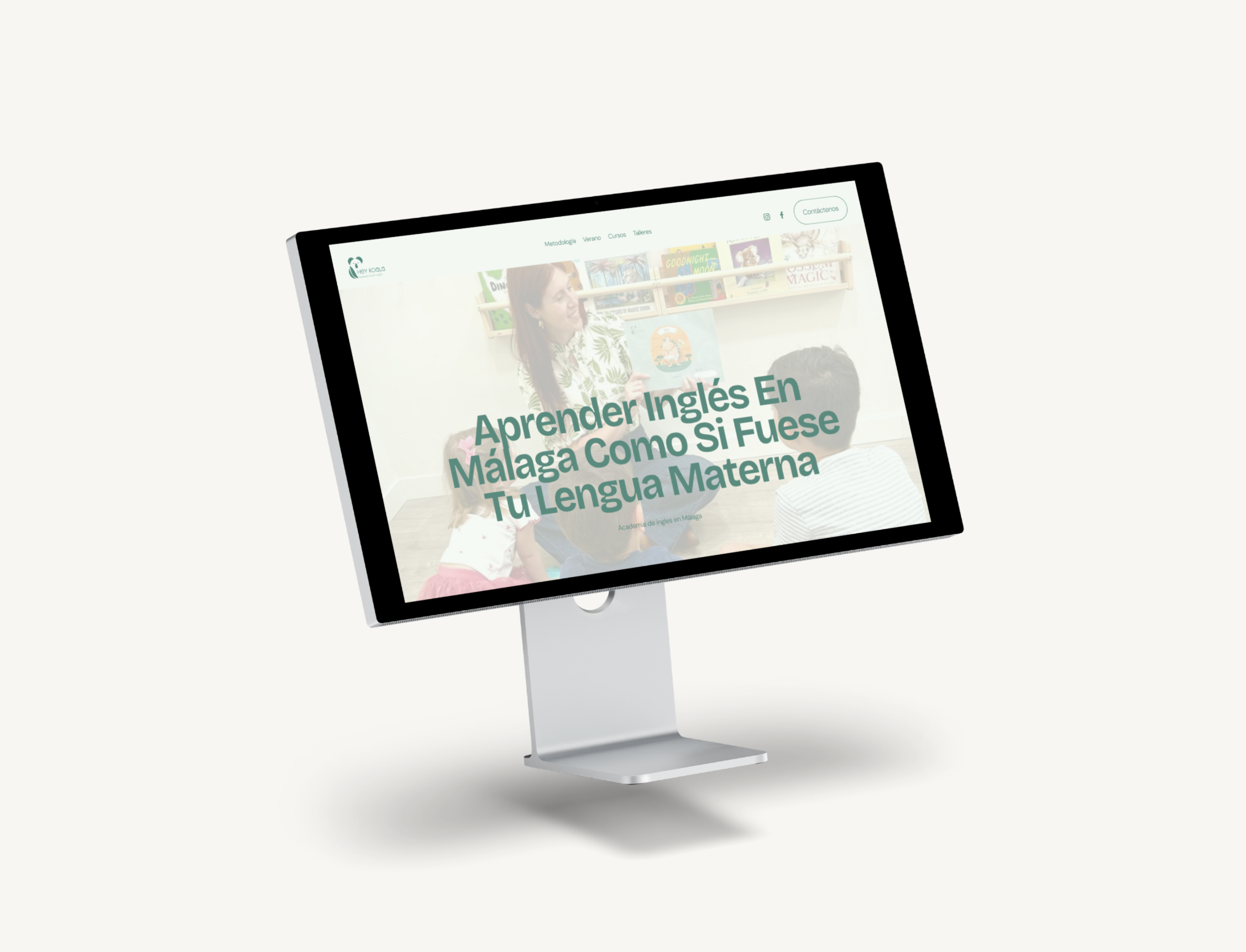
Where Hey Koala started
Steph built HeyKoala, a children's English academy in Málaga, over the better part of a decade, on a way of teaching that genuinely works. Hands-on, play-based and child-led, the kind of learning where kids absorb English by living it rather than studying it. It is rare in Spain, and it is good enough that word of mouth carried the school for years.
That is also how it became rootbound. It grew without a plan, the way good things often do, until it had outgrown the shape it was in. Steph was running near capacity with one part-time teacher and a few hours of admin, holding almost all of it herself. The roots had circled the pot.
The website showed the problem in miniature. A long draft led with the charming details, each level's characters and their personalities, while the things a family actually needs to choose a school, what each level teaches, the ages, the schedule, the price, how to enroll, were scattered or buried. The levels were grouped in a way that did not quite track. A method that was vivid in the room read as confusing on the page.


What changed?
Before: a method that worked in the room but read as confusing on the page, key information scattered, levels grouped oddly, and a business at the ceiling of one person's capacity.
After: a standardised, scannable structure that leads with what families need to decide, a method communicated as clearly as it is taught, and an academy credible enough to win and price a serious new contract.
The proof came quickly. A large local school handed HeyKoala its entire English programme. The new arrangement supported a rate close to double the in-house classes, and the brand and site made that value easy for families to trust rather than question. At the first enrolment evening, all 25 parents in the room signed their children up, and more were writing in before any follow-up.
How we got there
The academy's problem was never the teaching. It was that almost nothing was systematised, so everything depended on Steph. The work was standardisation: turning an intuitive, founder-led operation into something with a structure others could run and families could navigate on their own.
The website was the lever. Steph came to me with a long AI-generated outline, and the job was as much subtraction as addition. We took the cutesy lore out of the driver's seat and led every level page with what a parent needs first: ages, what the child learns and how, schedule, price, and one clear way to enroll. The characters stayed, as flavour rather than the headline. We regrouped the levels into a ladder that reads at a glance.
The clarity came from a set of questions I walked her through, the same five that became my workbook. The shift was from "what do we want to say about ourselves" to "what does a family need to know to choose us." That one reframe reorganised the whole site.
None of this was decoration. Standardising the levels and the site made the method legible and the business repeatable, and that is precisely what let Steph step into a bigger arena and be taken seriously in it.
"This brought structure and clarity to the whole process and made it actually manageable. I've got it mapped out now and I'm genuinely so ready."
"I genuinely couldn't have done the school expansion without you. You gave me the structure, the standardisation and the credibility to walk into something that big and be ready for it."
What it unlocked
The standardisation did more than win one contract. It gave Hey Koala a structure that can grow past a single person, the credibility to operate at a higher level, and the headroom for Steph to build what she wants to build next. The method was always the magic. Now it has the structure to match.